
News
JI Steel is committed to research & development, and providing a range of high quality,
innovative, cost-effective products and solutions for steel plant.
Ladle Slide Gate System: Technological Evolution and Industrial Upgrading of the “Heart Valve” for Steelmaking Flow Control
2026.7.23
I. Overview: A Critical Flow Control Device in the Steel Production Process
In modern continuous casting production, how to precisely and stably control the flow rate of hundreds of tonnes of high‑temperature molten steel is not only the bottom line for safe operation but also the key determinant of final strand quality. The ladle slide gate system (also known as the sliding nozzle system) is the critical device that fulfils this core mission. Installed at the bottom of the ladle, it drives the sliding plates through mechanical operation, dynamically adjusting the alignment of the upper and lower plate orifices to precisely regulate the flow rate of molten steel from the ladle to the tundish.
The concept of this technology dates back to 1884, but it was not until 1964 that it was successfully industrialised by the German company Benteler Steel. Over more than half a century of development, the slide gate system has evolved from a simple on‑off device into a complex system integrating precision machinery, high‑performance refractories, and intelligent control, becoming an indispensable pillar of stability in modern steel production.
II. System Structure and Working Principle
The ladle slide gate is essentially a precision mechanical valve installed at the bottom of the ladle, with its core being two or three refractory plates that can move relative to each other. By controlling the relative position of the plates through a drive mechanism, the central pouring orifices can be aligned, offset, or partially overlapped, thereby precisely opening, closing, or regulating the molten steel flow.
2.1 Structural Classification
Depending on the application scenario, the structural design of slide gates varies significantly. Ladle slide gates typically adopt a two‑plate configuration, whether of the linear reciprocating or rotary type, and their primary task is on‑off control of the steel stream. The upper plate is fixed below the ladle upper nozzle, while the lower plate is installed in a movable mechanism box. Before casting, the orifices of the upper and lower plates are offset, and the upper nozzle is filled with starting sand. During casting, the drive mechanism moves the lower plate so that the upper and lower orifices align instantly; the molten steel, under static pressure, flushes away the starting sand, achieving rapid start‑of‑cast.
In contrast, tundish slide gates are more complex, generally adopting a three‑plate structure to enable fine regulation of the molten steel flow entering the mould.
2.2 System Components
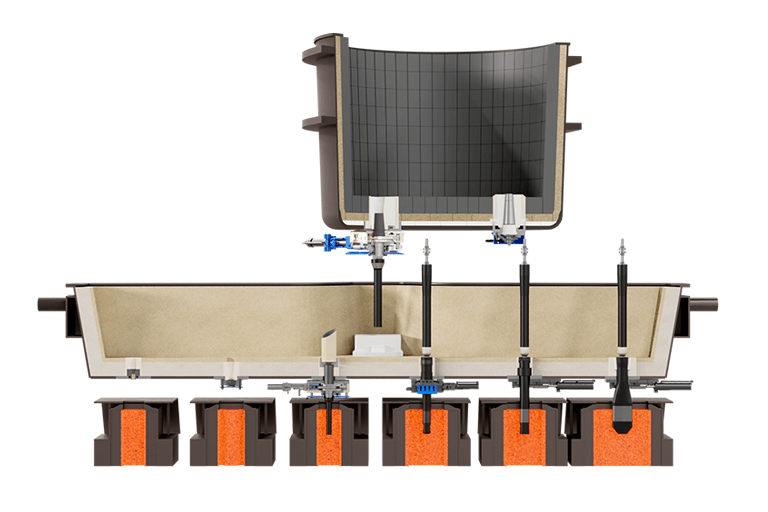
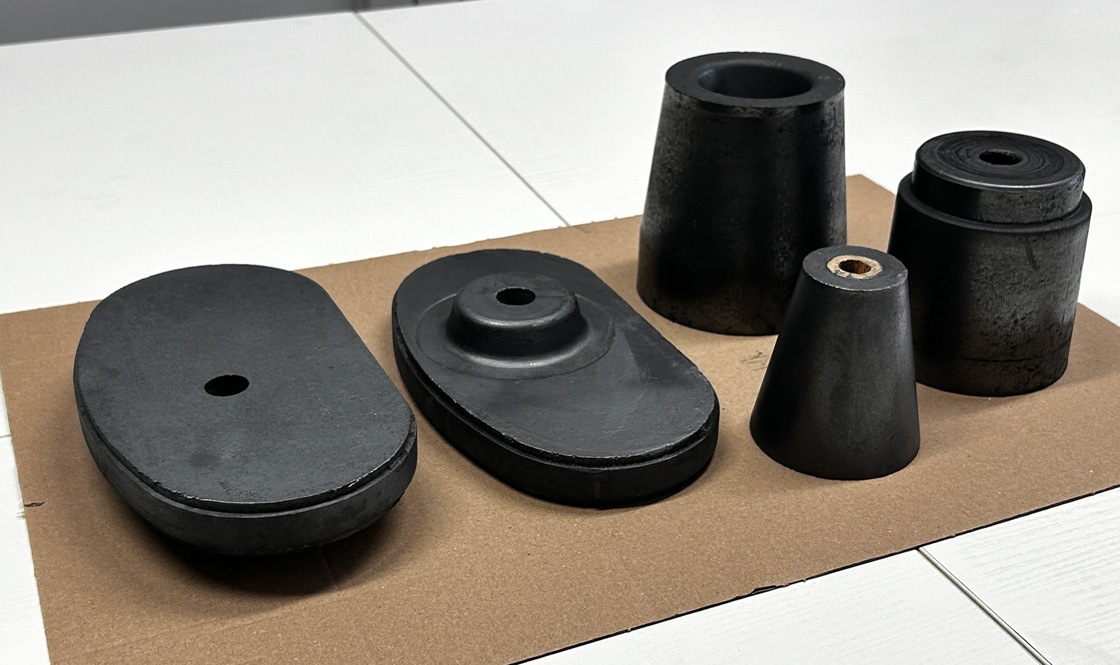
A complete ladle slide gate system consists of core components including the well block, nozzle bricks (including upper nozzle and lower nozzle), slide gate plates, and the drive mechanism (hydraulic/mechanical). These refractory components must operate stably in environments exceeding 1600°C, with strong corrosion and severe thermal shock. The well block fixes the nozzle position, the nozzle bricks guide the molten steel flow, and the slide plates regulate the flow through sliding motion – together, these three determine the system’s sealing performance, flow control precision, and service life.
The surface pressure between the slide plates in the slide gate mechanism is generally required to be controlled between 0.5 and 1.0 MPa. If the surface pressure is too low, steel leakage accidents may occur; if too high, excessive friction between the plates or mechanism components may result, making it impossible for the hydraulic cylinder to actuate.
III. Technological Evolution of Refractory Materials
The slide plate is the “heart” of the slide gate system; its material properties directly determine the service life and reliability of the entire device.
3.1 From Single‑Use to Multi‑Heat Continuous Casting
In the early stages of China’s steel industry, the refractories used in slide gate systems were mainly low‑cost, unfired products, with slide plates and nozzle bricks often used only once. Taking ladle slide plates as an example, early products were mostly low‑grade alumina‑carbon materials with an average life of only one heat.
With advances in refractory technology, slide plate life has achieved a leap forward. Leading international companies have now widely adopted high‑performance alumina‑zirconia‑carbon slide plates, achieving ladle slide plate lives of up to 8 heats. In China, the life of high‑quality alumina‑zirconia‑carbon and alumina‑carbon slide plates has been improved to 2‑4 heats, with some premium products approaching international standards. Upper nozzle materials have gradually transitioned to high‑purity corundum, chrome‑corundum, and composite alumina‑carbon bricks, with service lives reaching 20‑30 heats.
3.2 Material Diversification and Technological Innovation
The mainstream slide plate products currently on the market fall into three major categories:
Alumina‑Carbon Slide Plates: Made primarily from sintered corundum, silicon carbide, and carbonaceous materials such as graphite, formed by isostatic or mechanical pressing and then subjected to low‑temperature heat treatment. Traditional alumina‑carbon slide plates have a carbon content between 8% and 15%. These products combine the high‑temperature strength of corundum with the excellent erosion resistance of silicon carbide.
Alumina‑Zirconia‑Carbon Slide Plates: By introducing zirconia components, the erosion rate from molten steel and slag lines is effectively reduced. Alumina‑zirconia‑carbon slide plates are currently the most commonly used material for large and medium‑sized ladles and tundishes in steel plants.
Metal‑Corundum Composite Carbon‑Free Slide Plates: This represents an important technological breakthrough in recent years. The incorporation of a metallic plastic phase improves thermal shock stability while effectively reducing carbon content without compromising high‑temperature strength.
In terms of manufacturing processes, slide plates are divided into homogeneous and composite types. Composite slide plates represent a more economically efficient strategy – only the most severely worn and critical areas (the sliding surface and orifice zone) use high‑performance raw materials (such as fused corundum), while the main body uses lower‑cost materials. This design effectively controls overall cost while ensuring performance in critical zones.
3.3 Technological Breakthroughs by Domestic Enterprises
Chinese refractory companies have made notable progress in the slide gate field. Rongjin Shares focuses on slide gate series products, holding more than 80 national patents (including 29 invention patents), with an annual production capacity of 30,000 tonnes of high‑performance slide plates, capturing more than one‑tenth of the domestic niche market and supplying to over 100 large and medium‑sized steel enterprises including Baowu Steel, Anshan Steel, and Hebei Steel. Its new high‑performance low‑carbon slide plate bricks have been measured to reduce refractory cost per tonne of steel by 15%, and each production line reduces CO₂ emissions by 4,200 tonnes per year.
Guoliang New Materials, a national‑level “Little Giant” specialised and sophisticated enterprise, has mastered multiple core technologies including functional element design for molten steel purification, slide gate matching technology, and high‑performance long‑life integrated technology for ladles. As of June 2025, the company holds 5 Hebei Provincial Science and Technology Achievement certificates, 33 invention patents, and 52 utility model patents. Its “Slide Gate Plate Production Line Technical Transformation Project” introduces advanced automation, intelligent, and information technology equipment, which will significantly expand the production scale of slide gate products after commissioning.
Punai Shares has developed the PN315 slide gate mechanism, which features a compact structure, advanced technology, high safety and reliability, significantly extends the service life of refractory products, and enables multi‑heat continuous sliding operations.
IV. Market Landscape and Development Trends
4.1 Sustained Growth in Market Size
According to industry research statistics, the global ladle slide plate revenue in 2025 was approximately RMB 7.852 billion, and is expected to approach RMB 9.447 billion by 2032, with a compound annual growth rate (CAGR) of 2.8% from 2026 to 2032.
In the Chinese market, the slide gate market size reached RMB 4.86 billion in 2025, an increase of 31.2% from 2020, with a CAGR of 5.6%. The product structure continues to evolve towards higher‑end offerings. Alumina‑carbon, zirconia‑carbon, and composite‑structure slide gates account for 63.7%, 24.5%, and 10.7% of the market share, respectively. The self‑sufficiency rate of domestically produced high‑end products has risen to 72.4%, with some life indicators approaching international advanced levels. The regional distribution shows a pattern of “eastern leadership, central region emergence, and western follow‑up,” with East China, North China, and South China together accounting for over 77%, closely aligned with the layout of steel production capacity.
4.2 Challenges Facing the Industry
Despite considerable progress, the industry still faces multiple structural challenges: 70% of high‑purity zircon sand is imported; some domestically produced slide plates lag behind international advanced levels in microstructure design and sintering processes, with insufficient resistance to crack propagation; many steel mills tend to replace refractory components prematurely to avoid steel leakage risks, failing to fully exploit the material potential.
V. Intelligentisation and Automation: The Next‑Generation Slide Gate System
Intelligentisation is becoming a core direction in the technological evolution of slide gate systems.
5.1 Intelligent Detection and Automatic Control
In October 2025, Baoshan Iron & Steel Co., Ltd. obtained an invention patent for “An Automatic Detection Method and System for the Opening Degree of a Continuous Casting Ladle Slide Gate.” The system collects real‑time images of the follower object connected to the ladle lower‑plate nozzle, generates digital signal outputs, and, after analysis and processing by an image processing unit, obtains real‑time measurements reflecting the slide gate opening degree. This technology not only enables automatic optimal control of the slide gate opening before the end of ladle casting but also can be used for automatic alarm and interlock control in case of abnormal opening degrees, significantly improving production process monitoring precision and automation.
5.2 Robot Integration and Full‑Process Automation
Traditionally, the start‑of‑cast operation in continuous casting has relied heavily on manual control of the ladle slide gate by operators, requiring multiple personnel to observe the steel stream status and adjust parameters in real time. This not only involves high labour intensity but also introduces variability due to differences in operator experience, leading to fluctuations in start‑of‑cast stability.
In 2026, Xianggang Steel’s new bloom caster project publicly tendered the control system for an intelligent ladle casting platform. The system covers functional modules including automatic crane hook detection, automatic rotation and lifting of the ladle turret, automatic attachment and detachment of ladle slide gate cylinder systems, automatic media pipe plug‑in/out systems, automatic long nozzle attachment and detachment, automatic cover‑agent addition, and automatic temperature measurement and sampling systems. The project aims to achieve intelligent operation throughout the entire ladle casting process through integrated robot applications.
Internationally, an Italian steel plant has deployed a robotic workstation to assist technicians in performing complex maintenance tasks such as inspection, cleaning, and replacement of refractory components in the slide gate system. At the AISTech 2025 conference, machine learning methods were applied to model and optimise slide plate wear prediction, estimating centre‑hole diameter wear and crack formation to ensure operational safety, process stability, and reduce costs associated with premature slide plate replacement.
5.3 Optimisation and Innovation in Slide Plate Installation and Maintenance
In the field of slide plate installation and maintenance, multiple patented technologies continue to emerge. Lingyuan Steel has obtained a patent for “A Slide Plate Installation Structure for a Ladle and the Ladle,” which solves problems such as debris falling in and excessive operational force when the slide plate is on top and the tightening mechanism is on the bottom during ladle tilting. Handan Inovate Intelligent Technology has obtained a patent for “A Ladle Slide Gate Device,” which overcomes defects such as plate displacement and dust accumulation in the disc spring group through an integrated design. Shigang Jingcheng has developed a patent for an air‑cooled hydraulic cylinder for opening and closing the continuous casting ladle slide gate, effectively extending the service life of the hydraulic cylinder in high‑temperature environments.
VI. Outlook
Looking ahead, the ladle slide gate system will continue to evolve in the directions of higher performance, extended service life, intelligentisation, and green development.
On the materials front, the development of new products such as high‑performance alumina‑zirconia‑carbon slide plates and metal‑corundum composite carbon‑free slide plates will further enhance erosion resistance, thermal shock stability, and service life. On the mechanism front, surface pressure control accuracy, sealing performance, and operational convenience will continue to be optimised. On the intelligentisation front, deep integration of AI‑driven wear prediction, automatic start‑of‑cast control, robotic maintenance, and other technologies will drive the slide gate system from a “passive replacement” model to an “active prediction” intelligent maintenance paradigm.
As China’s steel industry continues its output optimisation and high‑quality development, the slide gate system, as the core flow‑control equipment for continuous casting, will provide solid support for the efficient, green, and intelligent transformation of the steel industry through its technological advancement and industrial upgrading.